
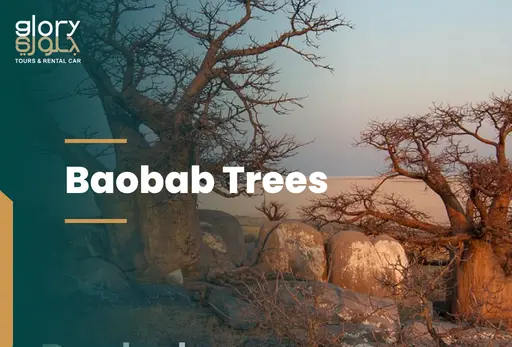
Baobab Trees in Salalah are one of the most unexpected natural sights in Oman.
When people think of Salalah, they picture beaches, coconut farms, and the khareef mist rolling over green hills. Few expect to see massive African baobabs rising from valleys in southern Arabia.
Yet they are here.
Scattered across parts of Dhofar, especially near Mirbat and Dhalkut, these trees stand as quiet reminders of a different ecological story. Fewer than 200 are documented in the region. That makes every single one important.
If you are visiting during the monsoon season, seeing Baobab Trees in Salalah should be part of your itinerary. The easiest way is through an East Salalah Half Day Tour or a full day guided experience that includes wadi stops and coastal viewpoints.
Let’s explore why these trees matter and why they deserve protection.
Why Baobab Trees in Salalah Are So Unique
The species found in southern Oman is Adansonia digitata, the African baobab.
It is native to sub-Saharan Africa. Its presence in Oman has long sparked debate.
Some researchers suggest seeds may have traveled by ocean currents or birds. Others believe ancient trade routes across the Arabian Sea introduced them centuries ago.
Oman News Agency Highlights Baobab Trees in Salalah
omannews.gov.om
Regardless of how they arrived, Baobab Trees in Salalah adapted to a marginal climate and survived. That resilience is what makes them extraordinary.
How Baobab Trees in Salalah Survive Harsh Conditions
Baobabs are designed for survival.
Their thick trunks store large amounts of water. During dry periods, they shed their leaves to reduce water loss. This deciduous behavior helps them endure long stretches without rainfall.
In Salalah, they benefit from:
- Khareef mist and seasonal moisture
- Wadi runoff
- Cooler monsoon temperatures
Touch the bark and you will notice a slightly fibrous texture. That structure allows internal water storage.
They are natural reservoirs standing in green valleys.
Ecological Importance of Baobab Trees in Salalah
Although small in number, Baobab Trees in Salalah play a strong ecological role.
They provide:
- Shade for wildlife
- Nesting sites for birds and bats
- Soil enrichment through leaf fall
- Micro-habitats in otherwise sparse landscapes
In a wadi environment, a mature baobab becomes a focal point. Life gathers around it.
These trees are not just large. They are functional.
Cultural Meaning of Baobab Trees in Salalah
In Africa, baobabs carry deep spiritual symbolism. In Salalah, their cultural role is quieter but still meaningful.
Local guides often describe them as:
- Ancient survivors
- Living landmarks
- Natural monuments
During khareef, when fog drifts through the valleys, a baobab silhouette feels almost cinematic.
They are treated more as heritage trees than as resources. That attitude helps preserve them.
Are Baobab Trees in Salalah Endangered?
Yes, they are vulnerable.
With fewer than 200 documented trees in Dhofar, the population is small. Any damage matters.
Threats include:
- Insect infestation
- Climate shifts
- Off-road driving
- Root damage from heavy foot traffic
- Expanding infrastructure
Local authorities have launched planting campaigns and monitoring programs, especially around Hasheer Plain.
Conservation is active. But visitor behavior makes a difference.
Best Places to See Baobab Trees in Salalah
If you want to see Baobab Trees in Salalah, here are key areas:
Wadi Hinna
Located east of Salalah.
Accessible and often included in guided tours.
Hasheer Plain
Near Mirbat.
A conservation focus area with planting initiatives.
Dhalkut
More remote and less crowded.
Ideal for experienced travelers with local guidance.
Booking an East Salalah Half Day Tour is often the most practical way to visit. A full day tour allows you to combine baobab stops with coastal cliffs, waterfalls, and frankincense sites.
Best Time to Visit Baobab Trees in Salalah
Khareef season from June to September is ideal.
During this time:
- Hills turn bright green
- Mist adds atmosphere
- Temperatures are cooler
Outside the monsoon, the trees remain impressive but the surroundings are drier.
For photography:
- Visit early morning or late afternoon
- Use wide-angle framing
- Include a person for scale
The size of the trunk becomes clear when someone stands beside it.
Explore Baobab Trees in Salalah with an East Salalah Tour
If you want to see the Baobab Trees in Salalah without worrying about directions, rough tracks, or missing hidden spots, booking a guided tour is the smartest option.
East Salalah Half Day Tour
An East Salalah Half Day Tour is perfect if you are short on time but still want a meaningful experience.
In just a few hours, you can:
- Visit Wadi Hinna and see baobab clusters
- Stop at scenic coastal viewpoints
- Explore parts of Mirbat
- Learn the ecological story behind these rare trees
A local guide explains how the baobabs arrived, how they survive, and why they are protected. You also avoid driving off-road yourself, which helps protect the fragile environment.
It’s efficient, informative, and relaxed.
East Salalah Full Day Tour
If you prefer a deeper experience, the East Salalah Full Day Tour gives you time to slow down.
You can combine:
- Baobab Trees in Salalah
- Wadis and waterfalls
- Coastal cliffs
- Historic Mirbat town
- Frankincense-related sites
With a full day, you are not rushing. You can walk around the baobabs properly, take photos during better light, and ask questions.
It becomes more than sightseeing. It becomes understanding the landscape.
Why a Guided Tour Makes a Difference
The baobabs are located in sensitive natural areas. Some are near wadis with uneven terrain. Others require local knowledge to access safely.
A guided East Salalah tour ensures:
- You stay on designated tracks
- You avoid damaging roots or habitats
- You learn the conservation story
- You travel comfortably
Most importantly, you experience the Baobab Trees in Salalah with context, not just as a photo stop.
If these rare giants are on your list, adding them to an East Salalah Half Day or Full Day Tour is one of the best ways to do it right.
Medicinal and Nutritional Aspects
Globally, the fruit of Adansonia digitata is rich in vitamin C, antioxidants, and fiber.
In Salalah, large-scale harvesting is not common due to conservation concerns.
Some fallen fruit may be examined by visitors, but removing large quantities is discouraged.
Preservation always comes first.
Climate Change and the Future of Baobab Trees in Salalah
Climate stability matters for these trees.
If monsoon patterns shift or mist decreases, their survival could become more difficult.
They are resilient, but they depend on specific environmental conditions found in Dhofar.
Protecting the broader ecosystem protects the trees.
Responsible Tourism Guidelines
When visiting Baobab Trees in Salalah:
- Do not climb trunks
- Avoid carving into bark
- Stay off exposed roots
- Take photos responsibly
- Leave no litter
These trees may live for centuries. Our footprint should be minimal.
Why Add Baobab Trees in Salalah to Your East Salalah Tour
If you are already exploring the region, adding a baobab stop is easy.
An East Salalah Half Day Tour works well for tight schedules. A full day tour allows more relaxed exploration.
Guides provide context about ecology, history, and conservation that you would likely miss on your own.
It turns a simple photo opportunity into a meaningful experience.
What Baobab Trees in Salalah Teach Us
They show that nature does not follow our expectations.
African giants thriving in southern Oman remind us how connected ecosystems once were.
They represent endurance, adaptation, and patience.
Standing beneath one, you feel both small and grateful.
Conclusion: A Natural Treasure Worth Protecting
Baobab Trees in Salalah are rare, resilient, and deeply important to Dhofar’s landscape.
They survived isolation and climate shifts. Today, they face new challenges from environmental change and human pressure.
If you visit, do it thoughtfully.
Support guided tours. Respect conservation rules. Share awareness with others.
And when you finally stand beneath one of these rare giants, take a quiet moment.
You are not just looking at a tree.
You are witnessing living history.